
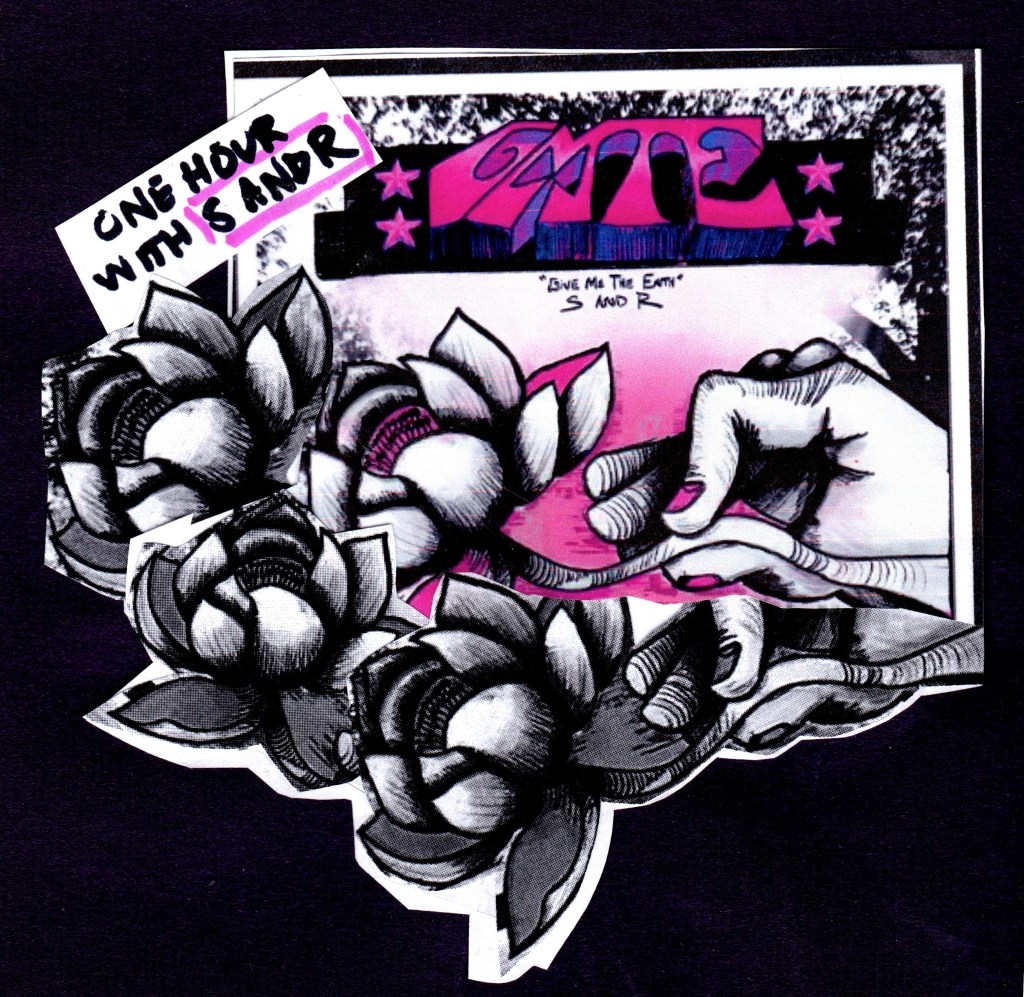
S AND R, an indie rock outfit consisting of Saxon (guitarist and vocalist), Reeve (drums), and Wen (keys/synth), recently released their infectious first single, “Give Me the Earth.” The track began as an acoustic piece performed solo by Saxon, but has since morphed into a catchy, groovy, rock-adjacent tune that’s a blast to listen to. Though the group loves to play with genre and has a wide range of influences between the three of them, their other music (only available live, for now!) is just as great as this first release.
S AND R, as implied by their name, was first a partnership between Saxon and Reeve. They have worked together since they were teenagers, and it shows in the musical synergy between the vocals/guitar and drums – as well as the way they finish each other’s sentences in conversation. Wen, a relatively new addition to the group, provides the perfect sonic backdrop against which Reeve and Saxon’s work shines.
Though the seed of the group was planted long before they got to Boston, I must mention that the members of S AND R are Berklee students. They’re obviously stars, and together, I wouldn’t be surprised if I saw them on tour and playing festivals within a year. The music – and the band – is that good.
All three members were kind enough to meet with me over Zoom to talk about the formation of the group, the evolution of their music, and their plans for the future.
Milo: Can you tell me a little about your music? How would you categorize yourselves as musicians, if you had to?
Saxon: We’re an indie alternative group pulling from influences in punk and hip hop, sometimes leaning into hip hop, sometimes leaning into punk influences…
Reeve: I think Saxon put that perfectly. I’d say we’re like an indie alt rock band with influences from genres like hip hop and punk.
S: The band’s centered around [us], Saxon and Reeve. It’s our lives together, our stories. That’s our musical glue.
M: That’s really cool! How did that collaboration start?
S: Reeve and I have known each other since we were kids. We grew up together in South Florida, and we started as a busking duo where we would perform on the streets, wherever they wouldn’t kick us out…and sometimes until they would kick us out.
We started dating in high school and started writing music together, arranging together, and really wanted to [start] a project that centered our stories. When we came to Berklee, we were able to reimagine and start building a full band structure around this idea.
We tried out some different band arrangements, but the most amazing thing has been having Wen on stage doing both keys and synth-based situations with both hands rather than [having] a larger band. It has that stripped down, intimate feel that is central to our sound.
M: Your first single is stellar, by the way. It does sound like there are influences on top of hip hop and punk, like R&B and jazz. Am I right?
S: Yeah! I’m always super influenced by R&B and jazz vocalists. I’m not primarily a vocalist, so I rely a lot on things that I hear. Having grown up on people like Nina Simone or even Fiona Apple in the 90s, [gives me] that indie songwriter vocal approach.
M [to Wen and Reeve]: How about you guys? What are you into?
R: Well, I feel like my biggest inspiration comes from classic rock. That’s where I started. So like Led Zepplin, stuff like that. I also take a lot of influences from punk and hip hop, like Anderson Paak.
Wen: I started off as a classical pianist, and then I got into a rock band, then a metal band, and now I’m here. I have a lot of influences, especially from more progressive metal stuff, more rhythmic.
And since I’m more of an electronic person in terms of what I’m studying, I’m not really focusing on piano performance anymore because that was my childhood. I like exploring sounds, synths, and it’s been really fun to come up with sounds for this band.
S: Wen’s sound design is a big part of our live shows as well. It’s interesting that you mentioned what you were hearing genre-wise. The way that I sometimes explain it to people is that we have a procession of genres that we use to convey different emotions, and the core instrumentation is always this indie alternative trio feel.
But we lean into punk when it’s angry, or we lean into R&B when it’s a little more chill. And when we do our live shows, it’s this building energy, and building energy, and building energy until a big punk rock catharsis that ties everything together.
What we’re able to do now that we’re starting to record these projects is take the audience’s hand and put them in these different environments, starting with “Give Me The Earth.”
M: Nice! It sounds like that song, the seed of it, is a historical seed.
S: Definitely. That was something I wrote more independently and we arranged together. It was the first song that I wrote about being openly queer and understanding my own identity. And it was also the first song that I performed when I got to Berklee. There’s a big open mic, our first week during orientation at Berklee. And ever since that open mic, people to this day will come up to me and sing the chorus. That’s how we knew this had to be the first thing we recorded. We had to put it out because people remembered it.
M: You don’t have to answer this if you don’t want to, but I wanted to ask: how does queerness and identity inform your work and performance?
S: I think a lot of aspects of identity find their way in our work. A lot of what we try to do is build community around very personal experiences. When I say something that’s very personal to me, that’s when I find [myself] connecting with people, and finding what the audience needs, rather than [saying] something universal.
I write things about queerness a lot. I write things about Asian identity, gender identity, things like that all find their way into the work. It’s also always in dialogue, because a lot of these are situated within real events that happen to me, or that have happened with me and Reeve within our relationship. It’s all intertwined.
M: Is that strange, using your relationship in that way?
R: I feel like it’s really enhanced our relationship together. Learning how we work with each other and how we figure stuff out together – it was definitely a process because we both are very stubborn on what we want, especially musically.
S: We definitely have visions.
R: But I think overall, learning to conform to each of our visions has [helped us] make the best music –
S: — we can make, yeah. We definitely build each other up. The fact that our lives are intertwined with the music doesn’t necessarily feel like we’re trying to get something out of each other. It feels more like we’re inviting people into the parts of our lives that we’re ready to share and want to connect more deeply with.
M: How did you two find Wen?
S: We tried different band arrangements, like having a bassist and keyboardist. We found that the more people we were bringing on, the more things got lost or muddled. With Wen’s background and sound design, and the fact that they’re able to do so much with just two hands, we were able to keep the intimacy of the sound and structure.
[To Wen] How has it been for you?
W: It was actually all through Josh. I didn’t know about them at all until I was introduced by Josh.
S: Backing up a little, I forgot to say that Josh, our roommate, has also been with us through this journey at Berklee. He’s acted as our manager. After the four-piece fell through, I gave him a laundry list of the things I wanted in a musician that we could work with. I didn’t want it to be a group of white guys at Berklee that we assembled for me to talk about my gender identity. I needed someone to relate to these stories. Then we met Wen, and it was like, oh my god. Yes.
W: I was actually very surprised when he approached me. Around that time, I was also deciding whether or not to stay in my band in Malaysia. I was thinking I wanted to expand my sound design here, and not be a full-time performer. I don’t think I’m going to go back home just to live that life. Since I’m in Boston, I decided I should try this.
[Wen to Saxon and Reeve]: What really made me want to do this is – when I listen to [these] songs – I love the lyrics. I love your voice. And then I was genuinely, genuinely interested in the songs. That’s actually very hard to do.
S: Right, that’s what we were looking for! We wanted to add on to this connection rather than back it with a band. We wanted to bring someone into the stories.
M: That’s amazing. I’m wondering, now that you’re here in Boston, how are you liking the scene? Is there anywhere you want to play?
S: I think that, for me, I really like intimate venues with a younger crowd. Things that are underground, in poor lighting, [with people] crowded around the stage. A lot of times that’s the place where people are connecting with this thing the best. I think that’s how we’re expanding our audience, because in those spaces we can really shine and catch people’s attention.
R: We don’t really have a specific place in mind that we want to play. It’s more of like, whatever comes our way, we’re willing to accept. I feel like that’s where we’re at right now. We’re ready to play.
M: Do you guys consider your live performance integral to the group, or are you more interested in recording?
S: I think they’re intertwined. We’ll have a gig, and [we’ll think of] something we could do in production to mimic the live sound. They play off each other. We don’t want to lose the energy of our live sound. Translating that to a recording is very important for us.
R: I agree with that. I feel like for me personally, now that we have one song released, I’m really excited about the production side of things, especially as I move along with the major I’m taking. I feel like it’s just a side [of music] I’m passionate about, and I’m excited to get more of our music out.
M: Is there anything coming soon, maybe an EP?
S: Our next steps were going to be another single called “The Botanist,” then after that, an EP. The idea is that we’re going down this road of evolving genres, where we start acoustic and build up the energy until we’re in a more intense punk rock stage. We really love to play with genre, and I think rolling it out in increments where you’re giving people a little more and a little more, that’s how we’re translating our live sound to recordings.
I think playing with genre is pretty key to what we do, but the instrumentation does stay somewhat similar. We’re able to surround this indie alternative core with other stuff. And in this age where people are more willing to bypass genre and just look at what the artist is doing emotionally – the genre is really just ornamentation to what we know we have.
M: Do you ever find that your intense musical backgrounds get in the way of making that emotional music?
W: For me, yes.
M: In what ways?
W: I used to compose very freely, and I didn’t care about a lot of things. I used to post it online, too, and a lot of people loved it. I would sometimes even post questions like, “what do you see when you listen to me play this?” I’d get so many answers – it was just so interesting. But then after getting to Berklee, I just don’t want to do that anymore. I miss that a little bit. I still do it when I’m back home with my piano.
R: I definitely get bogged down by the theory. I try really hard not to. I also play piano. I’m not a super good pianist, but –
S: – he’s an awesome pianist. He arranges a lot of the stuff on piano after I show it to him.
R: I think that when I try really hard, when I sit down at the piano…well, I really like improvising. I like to pick a key and just not think. I try hard to not think about the theory behind stuff. I don’t want to be like, technically this should be II, V, I or something like that.
S: It’s hard to have that open mind at Berklee because they do really instill in you certain rules. I will say that there have been times where I brought in a song I was working on and someone will say, “your structure is wrong.” That’s confusing to me as someone who’s not trying to follow a pop structure, and who likes pushing the boundaries. It discourages creative voices from experimenting with form.
What I love about this band is that we get to break the rules together and find ways that play to the audience’s emotions. I think that for me, theory strengthens my understanding of why weird things work. I find myself reverse-engineering my songs rather than applying rules from the get-go. I have to let myself experience the creative moment, and then analyze it.
M: That’s probably the healthy way to approach it, honestly. Did you guys get to do the summer stuff, like Porchfest or any Pride events?
S: Kind of! We played our release show at Brinstar, which was also a fundraiser. We released “Give Me the Earth” on the last day of Pride Month. It was really important to me that we had it out by June. I wanted it to feel celebratory, that we were able to bring all these things together.
Our release show brought together other queer-led bands and we raised money for trans mutual aid. Half of the money went to Black and Pink Massachusets, which provides resources to incarcerated queer people, and the other half went directly to a community member’s top surgery.
We’ll be playing some other shows next month, like the Start Where We Are Festival in the Common, which is focused on environmental issues.
M: That’s amazing. We’re at the end of our time – is there anything else you want to mention?
S: Well, there’s the show in the Common on September 10th. Did we mention our co-producer’s actual name? It’s Oscar Thom. And Josh T is the friend we’ve been talking about as our manager.
W: Another thing is that I also do music videos – I would love to direct one for us someday.
S: Absolutely.
M: Fantastic. I’ll be on the lookout for that. Well thank you for meeting with me, everyone!
I’m very excited about S AND R. As a young band and new arrival to the scene, they’re a breath of fresh air. Not only do they already know what they’re doing musically, they’re professional in a way many groups aren’t. Also, the music is just cool. You’ll be thinking about them long after the show ends. I am already waiting impatiently for their next release, and can’t wait to see them live. Make sure to check their music out on all streaming platforms, and visit their instagram while you’re at it!
 Wretched Press
Leave a comment