
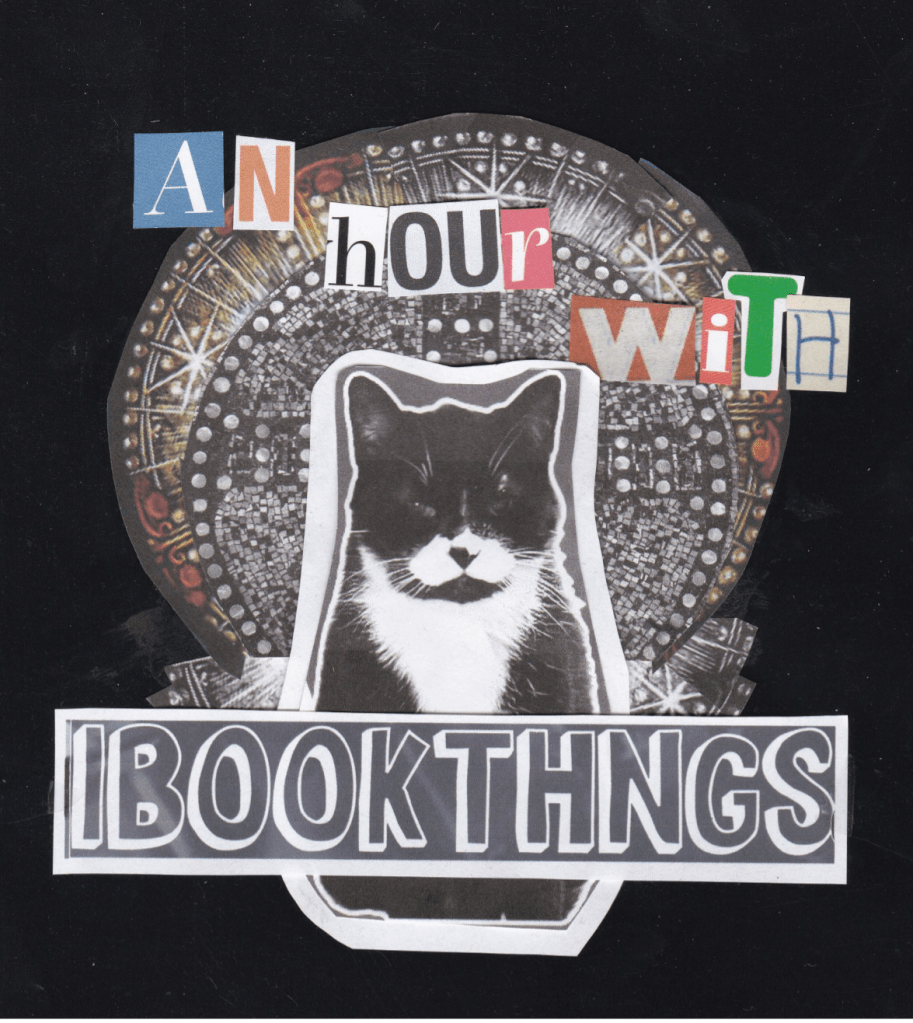
When I called Cody Rico, also known as Coco, we were both in bad shape. They were recovering from a series of spinal surgeries, I was in the throes of a nasty case of laryngitis, and still they were generous enough to speak with me about the Boston scene, their company (IBOOKTHINGS), and the importance of taking care of one another.
They are fun to listen to; I don’t see unbridled passion like that often, and I wish I recorded our call as a podcast so you could experience it firsthand.
Our conversation ranged from the practical, like venue logistics and their commitment to safety, to the metaphorical, like the necessity of recognizing the complexity of those around us. Coco is dedicated to their craft (and facilitating art is a craft) while also managing to be fun, sometimes silly, and always positive. I recommend attending one of their shows or seven – they truly create a community space in places that may not always feel that way.
M: Can you tell me a little about you and how you began to book shows?
C: I have been booking shows since about 2007 or [200]8, when I moved from California. At first, I was booking just for my own bands and friends’ bands. Basement shows, O’Brien’s, kind of smaller stuff. But my concentration for many of those years was touring, so I didn’t have the capacity to be home, or have money to go to shows, or have the capital to book shows.
But once the case of long COVID hit me and I was no longer touring with my main band, I picked up a couple contracts, and it snowballed from there. I remembered what I loved about booking my own tours, and that hit me really hard.
Also, I keep track of how many people come up to me and say that they appreciate [what I do], and that made me want to do more.
So that’s where I come from. I work in mutual aid efforts as well, trying to keep local community pantries filled, which is why we do food donations at all of my shows.
You said you’re a musician in the scene here – how does that impact your work?
A lot of my personal and professional work has involved music for the majority of my life. Now, not only as a musician do I get to play with a slew of great bands, but 4-5 nights a week, I get to see Boston’s best play.
It has been really fun to see the generations of bands through the years. There is often a story behind every band about how they formed out of the demise of previous bands, whom I also loved. I also think there is a certain amount of trust between a band and booking agent when the booking agent is also a musician.
When it comes to all the details for a show, being a musician means I can make sure to take care of everything that might otherwise be overlooked. Basically, there is a certain amount of “you get it” if you have lived out of a van for weeks on end with no money.
What do you think your biggest challenge is with booking shows?
Honestly, I think the biggest issue I have booking-wise is not finding bands to play, it’s figuring out which bands I can fit into slots to make it fruitful enough for the show spots to want to continue doing it.
As much as the DIY culture needs to exist here, Boston is also very much a money culture. These spots have to see no incidents and they have to see good bar sales. So I have to keep that in mind, while also trying to enrich the community with music that it really needs, now more than ever.
What does the booking process look like?
I have 2 or 3 different versions of what happens when I book shows. The first one would be: X local band or X touring band hits me up, we talk about dates and what they’re looking for, we find the date and venue that works best, and from there it will go one of two ways. [I’ll ask], “do you need me to find locals, or are you going to find people?” 90% of the time, they have friends they already have in mind.
Obviously, I still want to create a culture of people meeting new people, but I always like to have bands reach out to their friends first when they generally already have a lineup in their heads. Then, I reach out to [the other bands] and make sure they’re confirmed.
I will make a flyer and do all the internet things as well, like announcing, getting the ticket links set up, getting a Facebook event prepped, and all that stuff.
The second way is with a new band in the area. They’ll contact me and say, “hey, we’re a new band, we’re younger kids in the area, we don’t have much of a draw.” That’s when I really try to mix it up. I actually started an open-source spreadsheet that I help manage, which is an extensive list of bands split up by genre, their contact, [and] a link to music. I’ll just peruse that list and look for the bands who have been active in the scene and trying really hard.
I’ll reach out to them to play that show, so we get 4 bands who never would have otherwise played together. I have had many times when I booked two bands who didn’t know each other, and after playing and hitting it off personality-wise, went on tour together. Its a fun thing to see.
And then the third [way] is just an agent offer. Its a lot more business-oriented, which I don’t mind. I like to get as much music at any level into the city, but I definitely have a lot more fun with the smaller shows.
Is there a financial element to booking shows on your end?
Absolutely. Because there’s such a venue crisis in Boston right now, a lot of the places picking up the slack for shows are pop-up spots, like VFW halls. Not only is it very expensive to do those types of shows, but they’re very labor intensive. That’s the same thing with a couple of spots I have right now on a DIY level. [They] have to be set up and broken down every single time. The room cost comes just with the room most of the time; it doesn’t come with any staff, PA or anything else you might need.
Deep Cuts opening in Medford is going to be huge for the area, because it’s 240 cap, has a stage, [and] has all the amenities with that room cost involved.
[For example,] you go set up a show at the Elks, you pay $600, and then you also have to drag your own sound system in there and have staff. This is nothing [negative] on any of the places that do those things. They’re helping out our community.
But if I have a badly-attended show, I pay my staff so they don’t lose any money, but I lose money myself. You can’t exist in a culture losing money for a long time before you’re like, “I’m screwed.” Especially living in the area that has the highest housing and living costs in the US. Not to mention – the pop up shows all have to have PAs, stuff like that. I recently invested about $15,000 into a mobile PA system that I’m offering up to people for super affordable rates, based on what the show budget is, so these shows that are going in VFW halls will have the same experience audio-wise as going to a regular venue.
I wanted it to be an option for anyone booking shows to make sure the show can have good sound quality. At the end of the day, that’s what people want out of the show. People want it to sound good.
You’ve mentioned your staff a few times – can you tell me a little about them?
Technically, IBOOKTHINGS is just me, [but] there is a group of people I work with who also run their own booking entities. Shoutout to Oh Nice! Booking Collective on the North Shore, and Paul’s Place. Paul from Paul’s Place and Tyler from Oh Nice are my Monday and Wednesday night sound engineers at the Silhouette Lounge. Austin is the sound engineer for my Thursday nights at Notch Brewery; Austin is also on the team over at O’Brien’s as the Production Manager.
So that’s another cool thing: I got to hire a bunch of friends who kill it at what they do. IBOOKTHINGS is a solo operation as far as the booking and management goes, but if there were no bands there wouldn’t be a show. If there weren’t photographers, nobody would see the show afterward. If there weren’t any audio people, the show would sound bad, if it weren’t for people’s love of music there would be no audience…
So not just my shows, but no show is a single person operation. It takes a community to come together to make even a show for 25 people in a living room happen, all the way up through 50,000-person music festivals.
What kind of atmosphere do you aspire to create for the audience, but also for your staff?
I want to have an environment of a DIY show, but with the professionalism of any majorly booked show. I really want the band experience to [be good], especially some[where] like the Silhouette. I want a touring band to play there and be like, “this Monday night was the best show of tour.”
But beyond that, I pay my engineers and staff more than the starting wages at all the other major production spots in the city. I believe that everyone should have a livable wage – I just don’t have the heart to tell someone to do something knowing it’s too low of a rate for a person.
Also, that starts the conversation about paying our show staff more in the city in general. Because if a little no-name production company is paying their staff more than the largest production companies, then there’s something wrong.
So, if anyone’s looking for a job…[laughs]
It sounds like you make sure to keep humanity at the center of your work.
I don’t want anyone who’s working for me to feel like they have to [work for me] and I don’t want them to feel like they are just a number. That’s something that bothered me about working at those other larger productions. It was just clear that X accounting person in LA doesn’t know me as Cody Rico, they know me as employee 2386849.
I don’t want my employees to feel like they’re expendable. They are human beings, you know? They breathe, sleep, and get stressed out like anyone else. I try not to be someone who makes them uncomfortable to approach me for something. At the end of the day, we’re all trying to pull off the same damn thing here. We’re all musicians trying to throw shows. I think a lot of people have lost the human element in not just booking, but in the business management side of bands as well. Having a little bit of that human element warms my heart.
And then there are your humanitarian efforts…
Yes! I do food donations at all my shows; we can [also] take health supplies, [and] kitchen supplies. I distribute them to the local community pantries. I also try to make sure that my shows have staff on hand that are Narcan trained and hip to the language of harm reduction.
When I hire someone, they are representing me and my ideals, and if they don’t uphold those ideals, that can be a bad thing for me. One of my missions is to make sure that no one feels unsafe at any of my shows. I don’t want that to be an issue.
A lot of people probably appreciate all this work.
Yeah. I’ve talked to a lot of people about the food donations, especially. When I’m running a show, it takes me no more than 10 extra minutes to grab the food items at the end of the night, drive them down the street to the food pantry, and drive home. It’s a ten minute detour to ensure that someone, a living human being, is going to eat.
And I’m not trying to pat myself on the back here. I’m just saying that it doesn’t take much. I barely go out of my way, just attach a sentence to my posts and drop off some cans at the end of the night. I just want to put the real picture out there, because people view this as so much extra work, but no. It takes ten minutes out of my day to help someone eat. That’s important to me.
You mentioned working for bigger booking organizations. How did working as a production assistant influence your business, specifically?
I think that’s where a lot of the professionalism comes from. Safety is always a big factor for me.
Working at those [corporate] places, I actually saw some nasty accidents happen. I try to make sure that load-ins at my shows have the same professionality as a load-in at the Garden. It’s all the same goal. We don’t want anyone getting hurt, we just want everyone having fun, getting paid, and be[ing] able to live. And that’s not much to ask for, to be honest.
I didn’t do much formal education after high school, but working for LiveNation back in the day, it was like getting paid crappily to go to college. I learned everything. From working those big stages, from power, lighting, security – all I wanted to do was work every single job in-house. Now, I know 70- 80% of everything instead of 100% of one thing, which has been great as a manager and for booking.
Those companies played a pivotal role in my twenties for that reason, but [they] also [helped] me figure out morally how I wanted to run my company. I would never speak ill of any individual person I worked with at those companies. I learned more from them than any schoolteacher. They’re all wonderful. Sometimes it just comes down to the brass above that.
How would you advise people if they wanted to get into booking? Do you think your trajectory is the way to go?
Everyone always has to have their own way of doing things; that’s the beauty of it. Booking is sometimes as much as an art as music itself, and everyone has to express who they are while doing it. Everyone will fall into their own groove.
College is great if you have the means to go to college. Everyone is an individual, so I think it would be unfair [of me] to say “don’t go to college, because I turned out fine.” If you have the means, college is great. It teaches you organizational skills, it teaches you discipline – even waking up on time and all that stuff.
But I would say as far as music production goes, just do it. Do everything. Even the jobs you think have nothing to do with what you want to do, go do them so you know them. [You have to] see what you like best, because you might be like, I want to get into booking and I want to be a booking agent, then ten years down the line you’re going to be like, I fucking hate being a booking agent, and it turns out you were way better at doing sound.
Just do everything, absorb everything, keep your ears open, and don’t burn bridges.
Out of curiosity, I’ve been wondering who designs your marketing material?
I’m designing pretty much everything. Some bands will make their own show flyers, but I’d say I’m currently doing maybe 70% of all the flyers at the Silhouette, 100% of the flyers at Notch. Honestly, I have a lot of fun with it. I actually make a lot of flyers on my phone. If I’m out and about, sitting and waiting for a prescription at CVS, I’ll work on a flyer for 15 minutes.
I try to make it a little fun and funny, like my website – I modeled it to kind of look like an old Geocities website. My cat is posed as the CEO of the company, so whenever I make an announcement of any sort, it’s a picture of Misfit, my little buddy. And it’ll have a little sound bubble saying like, “hey, Misfit here!” The funny thing is that usually those posts are the most liked posts.
Misfit is technically the head honcho and I’m just an office assistant.
People do love cats.
Well you know, it’s the same thing with the name “IBOOKTHINGS.” I want to be as professional as I can, but still not take myself too seriously. That punk, DIY ethos and professionality can go hand in hand.
I imagine that also keeps it from feeling like a chore.
There are very few things in my business that feel like a chore. It’s kind of the same mentality that people say about tour: your worst day on tour is still better than your best day at a job. Which, you know, can’t be totally true for all the experiences I’ve had on tour, but generally, yeah.
Do you want to drop the name of your band, or would you rather not because of the hiatus?
We’re taking a break, but I did the vocals for a metal band called Vaulted. Also, I am currently healing myself back to drum-playing capabilities for an indie rock/pop-punk project called Cape Crush.
I actually did the entire EP and found out eight or nine days later that I had spinal degeneration, and I was like, well, that was one of the coolest last things I could’ve done before all this.
If you’d like to plug anything else, please go for it!
I want people to know that on top of the shows I’m already doing, at the rental spot Garage B in Brighton that’s attached to The Speedway, and the Silhouette, and Notch, we’re opening a new show spot in Allston that’s going to be located at a place called Field’s West. Hopefully it will start having music almost every night of the week in a few months.
With the closure of Great Scott, people have been saying that things have been sucking for music in the area, and yes, we took some huge losses, but there are things on the horizon. I can’t tell you how exciting 2025 is going to be for Allston and Boston.
And just think about the person next to you. Think about the person in the front and back of you, think about the person who can’t afford food, think about the person who can’t afford housing. Just look at someone like they’re human like yourself.
Something that drives me in my business is that a lot of people have just lost their human connection. I want to make it apparent that I am here, and that if you have an issue with something that I do, tell me. I will make adjustments, I will work with you. I am here to serve the community, not the other way around.
//
There are many things I could say about Coco, but what stuck out to me is how genuinely kind they are. Kindness is a skill, not just a character trait. It’s something you work on, something you pursue, and it is obvious Coco pursues kindness.
And yes, I know that this was a long interview, but Coco’s story is compelling, their advice is ridiculously useful. Even if I wanted to cut something out, I’d have no idea where to start. So what you see here is the bulk of our phone call, edited only for clarity.
I can’t wait to see what’s coming to Boston and Allston in the coming months and years; they couldn’t legally talk about everything yet, but I’m sure we’ll be getting some great additions to the music community in the area. Keep an eye out for any updates with Coco and IBOOKTHINGS through their instagram and website (www.IBOOKTHINGS.com). You can keep up with us at Wretched Press here, or on our instagram as well.
Author:
Milo, Editor and Founder
 Wretched Press
Leave a comment